



When planning a grouting project, temperature could determine whether you’ll meet deadlines and performance specifications. Understanding how temperature impacts grout strength isn’t as simple as checking the weather forecast. The thermal dynamics at play are complex and critical to project success.
Understanding Real Temperature Conditions
The temperature that matters for your grout project isn’t what the thermometer reads. It’s a composite of multiple factors: your grout material temperature, equipment temperature, and the surrounding environment where the grout cures.
Consider a grouting project scheduled for a perfect 70-degree day. If your crew starts at 6 AM, the material stored overnight might be at 50 degrees. Your substrate could be even cooler. The actual working temperature might be 15-20 degrees below target, significantly affecting cure times and strength development.
That same 70-degree forecast might represent morning temperature, with afternoon conditions reaching 85-90 degrees. Crews placing grout at 2 PM work in an entirely different thermal environment, even on the same day.
How Temperature Controls Grout Curing
Temperature fundamentally affects the chemical reactions that allow grout to cure and gain strength. Higher temperatures accelerate reactions, speeding the curing process. Lower temperatures extend the time needed to achieve target strength levels.
This creates dramatic differences in project timelines, often determining whether you open a facility on schedule or face costly delays.
Grout Strength Data at Different Temperatures
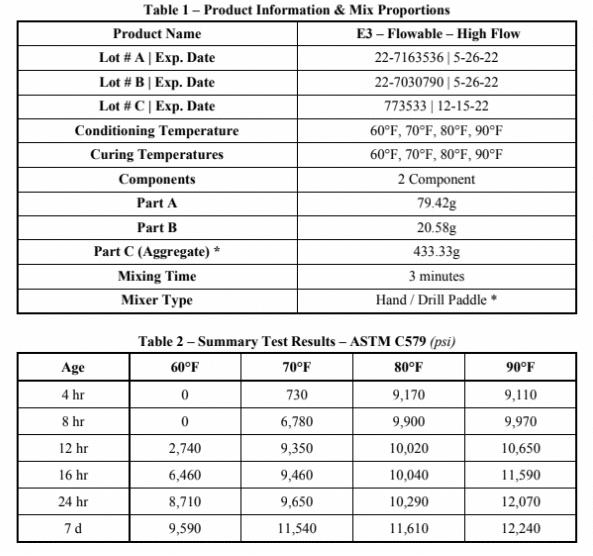
Actual performance data from commercial epoxy grout demonstrates the temperature-strength relationship. Most grout manufacturers specify working conditions of 70°F or warmer, but advanced formulations perform across wider ranges.
Examining 24-hour compressive strength values for the same epoxy grout:
- 60°F: 8,700 PSI (baseline for cooler conditions)
- 70°F: 9,650 PSI (11% increase, standard cure condition)
- 80°F: 10,200 PSI (continued strength gains from accelerated curing)
- 90°F: 12,000 PSI (highest early strength, fastest return to service)
The 1,000 PSI difference between 60°F and 70°F could determine whether you proceed with construction on schedule or wait additional days for the grout to reach load-bearing capacity. The real differences are at lower temps, soon after placement. Take a look at the example below.
Temperature Management for Fast-Track Projects
In industrial settings, every hour of downtime costs thousands or tens of thousands of dollars. Manufacturing facilities, bridge reopenings, and commercial grand openings make temperature management a financial imperative.
At higher temperatures, you might achieve in 18 hours what takes 36 hours at cooler temperatures. For tight deadline projects, this acceleration separates success from failure.
Cold Weather Grouting Strategies
Winter construction schedules, emergency repairs, or maintenance windows sometimes force work in less-than-ideal temperatures. Strategic planning allows safe, effective progress:
- Heat materials before mixing
- Use insulated blankets or heated enclosures around work areas
- Extend cure time calculations for slower strength development
- Schedule critical loads for 36 hours post-placement at 60°F
- Apply supplemental heating to accelerate curing
Hot Weather Applications
Controlled higher temperatures accelerate fast-track projects. When you need rapid strength gain and quick return to service, warmer conditions dramatically improve timelines.
Proper management prevents issues like rapid moisture loss or thermal cracking. Warm-weather grouting can convert a 48-hour cure cycle into 24-hour turnaround, saving an entire day on your critical path.
Year-Round Quality Consistency
Understanding the temperature-strength curve maintains consistent quality across seasons and climates. Summer and winter jobs both meet identical performance specifications by adjusting your approach based on thermal conditions.
Common Temperature Management Mistakes
The biggest mistake isn’t working in challenging conditions but failing to account for temperature at all. This creates:
Premature Loading: Assuming grout reached design strength on a “normal” timeline when it was actually curing cooler and hasn’t achieved adequate strength. This causes grout failure, equipment misalignment, or structural issues.
Unexpected Delays: Discovering too late that cooler temperatures extended cure time, disrupting schedules and potentially triggering penalty clauses.
Material Waste: Mixing in extreme temperatures without planning results in material that sets too quickly (heat) or too slowly (cold).
Inconsistent Results: Batches curing at different temperatures create strength variations across installations, causing differential settlement or performance problems.
Temperature Control Best Practices
Implement these essential grout temperature management strategies:
Pre-Project Planning: Review historical weather data for your location and timeframe. Consider daily temperature swings, overnight lows, and specific placement times.
Material Storage: Store grout components in temperature-controlled environments. Field work requires insulated containers or climate-controlled trailers. Bring cold material to working temperature before mixing.
Substrate Conditioning: A concrete slab sitting at 50°F overnight pulls heat from your grout, lowering cure temperature regardless of air temperature.
Monitoring and Documentation: Use infrared thermometers or data loggers to track material and substrate temperatures throughout placement and curing. This protects you if questions arise and provides data for future projects.
Contingency Planning: Prepare backup plans for unexpected temperature swings: heating equipment for cold snaps, shading and cooling for heat waves.
Team Communication: Ensure everyone (material suppliers, schedulers, quality control personnel) understands temperature requirements and timeline impacts.
Temperature as a Competitive Advantage
Temperature is a fundamental variable affecting every aspect of your project’s performance, timeline, and success. Contractors and engineers who treat temperature as a strategic factor consistently achieve better outcomes than those hoping for good weather.
The temperature-strength relationship gives you control over results. Planning for thermal conditions as carefully as mix designs and placement procedures transforms potential obstacles into competitive advantages.
Don’t just check the weather forecast. Develop a comprehensive thermal management strategy accounting for material temperature, substrate conditions, environmental factors, and their combined effect on cure time. This attention to detail separates successful projects from troubled ones and distinguishes industry leaders from everyone else.
Key Takeaways for Grout Temperature Control
- Measure actual material and substrate temperatures, not just air temperature
- Account for 1,000+ PSI strength variations between 60°F and 70°F conditions
- Plan cure schedules based on actual thermal conditions
- Use temperature strategically: heat for faster curing, controlled conditions for consistency
- Document temperature data throughout the placement and curing process
- Prepare contingency plans for unexpected temperature fluctuations
Effective grout temperature management isn’t optional for professional results. Master these principles to deliver projects on time, on budget, and to specification regardless of weather conditions.